Roof rat exclusion & trapping in Miami Lakes resolves structural breaches where mature canopy trees meet Spanish S-tile or barrel tile rooflines. The invasive black rat ( University of Florida IFAS Extension ) exploits…
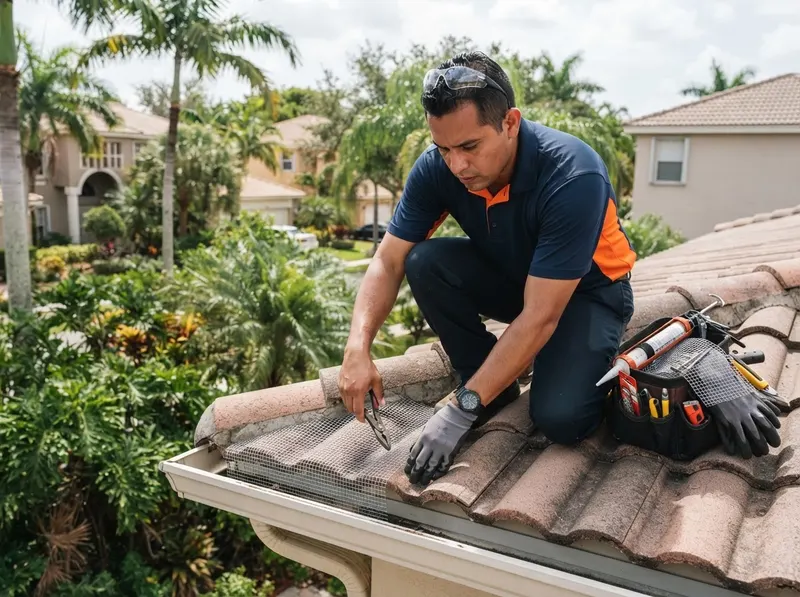
Roof rat exclusion & trapping in Miami Lakes resolves structural breaches where mature canopy trees meet Spanish S-tile or barrel tile rooflines. The invasive black rat (University of Florida IFAS Extension) exploits openings as narrow as 0.5 inches along fascia joints, lead pipe jacks, and air conditioning line chases. In established residential developments like Loch Ness Community, Royal Oaks, and Windmill Gate, large live oaks and mature palms provide aerial highways over ridge vents. Unlike subterranean Norway rats, roof rats spend up to 90 percent of their active foraging life above ground level, chewing through exterior foam backer rods, soffit vents, and electrical wiring conduit inside attic voids. A failure to mechanically seal entry points renders interior baiting useless, because high outdoor moisture and citrus trees near Lake Clarke Shores enclave and Miami Lakes Loch Isle draw continuous replacement populations into unprotected structures.
Decision guidance relies on an inspection of entry architecture and interior attic evidence. If rat droppings measure 0.5 inches with pointed ends and smear marks appear on rafters, the target species is Rattus rattus rather than common house mice. Mechanical containment must precede any rodenticide deployment. In accordance with guidelines from the U.S. Environmental Protection Agency, placing unsecured bait blocks inside ceilings creates severe secondary poisoning hazards for domestic animals and results in foul odor from carcasses decaying inside unreachable wall cavities. Trapping utilizes expanded-trigger snap traps calibrated with friction catches, stationed perpendicular to ceiling joists along active rub lines. Exclusion crews install 0.25-inch, 16-gauge hot-dipped galvanized hardware cloth conforming to standards outlined by the ASTM International, reinforced with polyurethane elastomeric sealant compliant with Miami-Dade County Building Code wind-driven rain tolerances.
Attic remediation addresses the biohazard footprint left by established colonies. Rat urine deposits contain protein allergens and airborne pathogens documented by the Centers for Disease Control and Prevention. When thermal imaging reveals compressed, contaminated R-30 blown-in fiberglass insulation around Town Center Bull Run or Gramercy Park residences, technicians extract the ruined substrate under negative air pressure using HEPA filtration defined by the Occupational Safety and Health Administration. Crews apply broad-spectrum antimicrobial mists registered with the Florida Department of Agriculture and Consumer Services to neutralize ectoparasites such as tropical rat mites (Ornithonyssus bacoti) and salmonella bacteria, restoring structural safety across the home. SafeHarbor Pest Removal maintains strict domestic sanctuary through multi-stage exclusion barriers rather than temporary chemical band-aids.
Step-by-step structural containment follows a five-stage deployment sequence. First, technicians inspect the entire perimeter from foundation sill plates to roof peaks, cataloging all utility penetrations exceeding 0.25 inches. Second, one-way exit doors or mechanical traps are secured along primary runways to prevent trapped animals from gnawing interior drywall. Third, technicians fit custom-cut galvanized metal flashing behind barrel tiles and screen vents across neighborhoods like Loch Lomond, Silver Crest, and Royal Palm Estates. Fourth, daily trap inspections reset triggers, record capture counts, and confirm colony depletion. Fifth, crews run thermal smoke tests along the roof deck to verify an airtight barrier before issuing a final clearance report.
Every job gets a firm, written price after a free on-site visit.
For standards, safe disposal, and service guidance on pest control services in Miami Lakes, FL, useful references include U.S. EPA, ENERGY STAR, U.S. Dept. of Energy, Consumer.gov, U.S. Census Bureau, and Google Maps. General consumer and small-business resources are available from USA.gov, Better Business Bureau, FTC Consumer Advice, U.S. Small Business Administration, and Ready.gov.
Tell us about your roof rat exclusion & trapping job in Miami Lakes and we'll send a clear, written quote, usually the same day.
 SafeHarbor Pest Removal