Drywood termite spot treatment provides localized structural protection against Cryptotermes brevis , the prevalent domestic drywood species documented by the University of Florida Entomology Department . In…
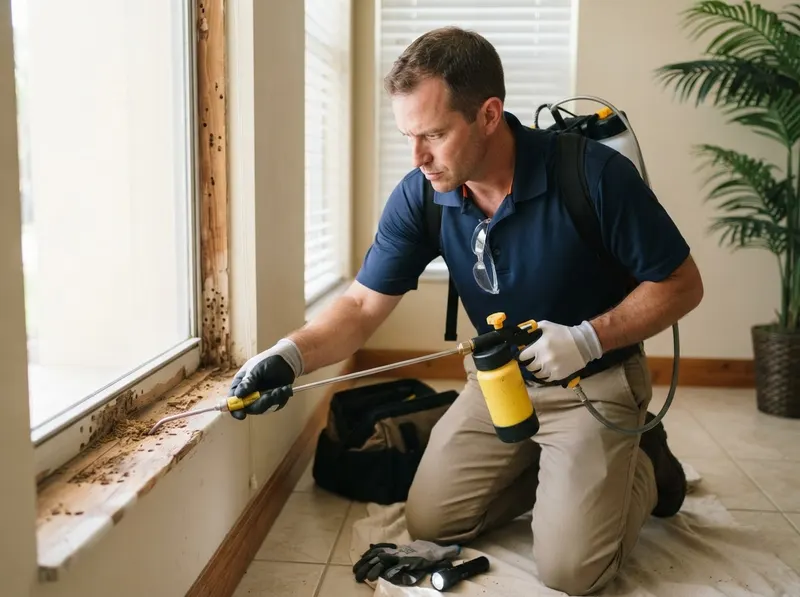
Drywood termite spot treatment provides localized structural protection against Cryptotermes brevis, the prevalent domestic drywood species documented by the University of Florida Entomology Department. In residential communities such as Royal Oaks, Windmill Gate, and Miami Lakes Loch Isle, subterranean moisture is not required for these insects to thrive. Drywood alates enter attic vents and exposed eaves during spring mating swarms, establishing autonomous colonies entirely inside dry wood members. Structural framing specifications outlined by the Florida Building Commission require resilient assemblies, yet unsealed architectural trims remain vulnerable. When termite evidence presents as distinct hexagonal fecal pellets, termed frass, beneath a single door frame or rafter tail, localized spot treatment serves as the primary tactical intervention. SafeHarbor Pest Removal isolates the infested gallery network, using drill-and-inject procedures that introduce expanding foam formulations directly into feeding channels without displacing occupants from their homes.
Selecting between targeted spot treatment and whole-structure fumigation depends on the spatial distribution of the infestation. Spot treatments fit single-site discoveries, such as localized activity in a kitchen header in Loch Lomond or fascia wood near Don Shula's Golf Club (The Senator Course). Spot applications preserve domestic routines by eliminating the multi-day evacuation, exterior bagging, and food removal required under EPA pesticide regulations for structural gassing. However, if termite colonies have dispersed into inaccessible wall voids, concealed subflooring, or multiple roof planes, whole-structure fumigation becomes necessary. The operational trade-off of localized injection is geographic confinement: it stops active destruction within the treated gallery zone and saturates the immediate substrate, but it does not protect untreated wood assemblies twenty feet away. For preventative fortification, applicators apply soluble disodium octaborate tetrahydrate, regulated under FDACS pesticide standards, which diffuses into raw wood pores to halt digestive protozoa inside newly landing swarmers.
Treatment execution follows strict technical standards established by the National Pest Management Association. SafeHarbor Pest Removal technicians inspect framing using acoustic emission sensors and moisture meters calibrated against NIST standards to chart internal wood voids. Once galleries are mapped, technicians bore micro-apertures measuring 1/8th inch (0.32 cm) directly into the infested timber. Pressurized liquid or foam termiticides, monitored under NIOSH occupational safety guidelines, are injected until the internal cavity network is fully flooded. The expanding foam carries active non-repellent termiticides through concealed galleries, transferring through grooming contact across the entire localized colony. Surface applications follow OSHA respiratory safety protocols, locking chemical residuals into unfinished roof trusses adjacent to Miami Lakes Optimist Park and residential properties bordering Roberto Alonso Community Center.
Environmental conditions across Miami-Dade County accelerate wood degradation when termite activity is compounded by subtropical ambient humidity. Guidance from the Florida Power & Light energy efficiency database notes that conditioned indoor air adjacent to unconditioned attic spaces creates condensation along rafter plates, softening wood fibers and accelerating drywood colony establishment. SafeHarbor Pest Removal stabilizes structural integrity by pairing localized foam injections with broad-spectrum borate coatings on bare structural lumber, adhering to conservation parameters published by the USDA Forest Products Laboratory. This combined approach eradicates active internal galleries while rendering the surrounding substrate unpalatable to future swarms traversing Gramercy Park, Silver Crest, and Royal Palm Estates.
Every job gets a firm, written price after a free on-site visit.
For standards, safe disposal, and service guidance on pest control services in Miami Lakes, FL, useful references include U.S. EPA, ENERGY STAR, U.S. Dept. of Energy, Consumer.gov, U.S. Census Bureau, and Google Maps. General consumer and small-business resources are available from USA.gov, Better Business Bureau, FTC Consumer Advice, U.S. Small Business Administration, and Ready.gov.
Tell us about your drywood termite spot treatment job in Miami Lakes and we'll send a clear, written quote, usually the same day.
 SafeHarbor Pest Removal